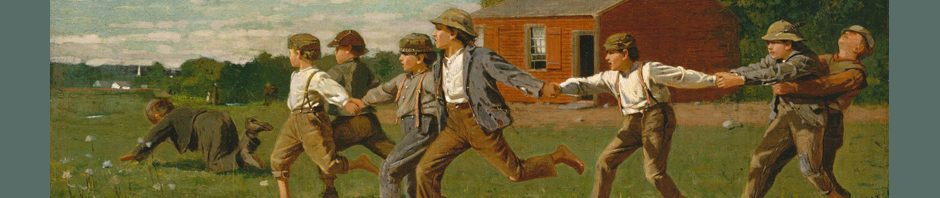
Mrs. Tilden Suffers a Meltdown

“OK class… here are your parts for today. Gifford you’re Caesar. Martin you’re Antony. Jean-Margaret you’re Calpurnia. Elizabeth you’ll be Portia. Gaylord… Cicero. Lawrence… Brutus. Tall Simon… Cassius. Red Hair Simon… Casca. And Fitzhugh, you’re Titus Vestricious Spurinna the Soothsayer…”

Say what you will… but each of us moves to the unique rhythms of the seasons and the comings and goings of the moon’s phases. Some of us are less tuned in to the seasonal changes and the lunar cycles. But few who could be more ruled by the time and day of the year, than Agnes Tilden, Class of ’16 Mount Holyoke, Summa Cum Laude in English Literature, and a Fifth Grade Teacher at The Middlesex School. You could tell it was October, early in the school year, because without variation, year after year, after year, she would regale her class with Washington Irving’s tale Legend of Sleepy Hollow. She found great satisfaction in reading aloud to the class… sharing a classic piece of American Literature. To help enact the scenes, she would enlist students to portray the roles of Ichabod Crane, Brom Bones and Katrina Van Tassel. If she had her druthers, she would have turned off the fluorescent lights with their annoying hum, and bathed the room in candlelight.

Beginning after WWII, every November a class trip to Old Sturbridge Village would be organized. You could count on it, just as you could count on the students’ amazement at the size of the one room District School.

December was the time for Charles Dickens’ A Christmas Carol. Reading to the class she expressed Scrooge’s skepticism at seeing the ghostly apparition of the deceased Jacob Marley, “You may be an undigested bit of beef, a blot of mustard, a crumb of cheese, a fragment of underdone potato.”

Marcia Peterson, the Sixth Grade Teacher, would say, “You could fall into a coma for ten years, awaken, walk into Aggie’s classroom and tell what month it was, and probably the day, by what she was reading or doing with her class.”

March was the month for Shakespeare. And it had to be Julius Caesar. You could count on it.

“Class we are in Act I, Scene II… Gifford you begin.”

CAESAR: Calpurnia!

CASCA: Peace, ho! Caesar speaks.

CAESAR: Calpurnia!

CALPURNIA: Here, my lord.

CAESAR: Stand you directly in Antonius’ way, when he doth run his course. Antonious!

ANTONY: Caesar, my lord?

CAESAR: Forget not, in your speed, Antonius, to touch Calpurnia; for our elders say, the barren, touched in this holy chase, shake off their sterile curse.

ANTONY: I shall remember: When Caesar says ‘do this’, it is perform’d.

CAESAR: Set on; an leave no ceremony out.

“Fitzhugh? Fitzhugh, you have the next line….”

“Mrs. Tilden… what’s a Soothsayer?”

“It’s a person who makes predictions about what will happen in the future, and then makes a public pronouncement…”

“I get it. Like my Dad, when he plays golf with my Uncle Colin and he tells him that if he uses a 7 iron on the Par 3 Second Hole, he’ll put his tee shot into the pond. And Uncle Colin ignores him, saying that my Dad was just messing with his head, and sure enough Uncle Colin plunks his ball into the water a good 15′ short of the green!”

“Fitzhugh… that’s a charming story. But within the context of Julius Caesar, a soothsayer refers to a person who has a natural gift, and the wisdom to see into the future. Maybe more like a fortune teller, or an Oracle, and it was serious…”

“Well, it sure was serious with my Uncle Colin. He told my Dad that he just lost his favorite-good-luck golf ball, and that if my Dad didn’t shut up, he was going to take his putter and hit him on the coconut with it!”

“It sounds like your Uncle has anger management issues…”

“You can say that again. My Dad is always telling him that he picks the wrong ‘horses’. My Dad explained to me that ‘horses’ is just an expression… and that it referred to picking bad stocks, backing bad political candidates, and being miserable at choosing wives. One time, when Dad told him that the person he voted for was a jerk, Uncle Colin threw his gin ‘n’ tonic against the wall!”

“Yes… let’s return to the play. Fitzhugh, it’s your line.”

SOOTHSAYER: Caesar!

CAESAR: Ha! Who calls?

CASCA: Bid every noise be still: peace yet again!

CAESAR: Who is it in the press that calls on me? I hear a tongue, shriller than all the music, cry ‘Caesar!’ Speak; Caesar is turn’d to hear.

SOOTHSAYER: Beware the ides of March.

“Mrs. Tilden… I have a question. What are ides?”

“Fitzhugh… it means the mid-point day of the month. And the mid-point in March would fall on the 15th day. Back in those days, it was a way that they marked the calendar. Gifford, it’s your line.”

CAESAR: What man is that?

BRUTUS: A soothsayer bids you beware of the ides of March.

“Mrs. Tilden I have a question.”

“What is it now Fitzhugh?”

“Mrs. Tilden. I was born on February 15th… does that mean I was born on the ides of February?”

“No, Fitzhugh. And I know it may sound confusing… but ides falls on the 15th day of March, May, July and October. In the other months ides falls on the 13th day.”

“Mrs. Tilden, this is so confusing. Ides of March? Why not just say March 15th? Why didn’t Shakespeare just write, ‘Watch yourself on March 15th’, or ‘On March 15th be careful’, or ‘Pssst! Caesar! March 15th will be a very bad day for you.’ This ides stuff, it could be the 13th or the 15th… you know, how was Caesar supposed to know. Unless Shakespeare had the soothsayer tell him exactly what it meant.”

“Fitzhugh, enough. Caesar knew exactly when the ides of March was. As we will see, he chose to ignore the warning. Gifford, your line.”

CAESAR: Set him before me; let me see his face.

CASSIUS: Fellow, come from the throng; look upon Caesar.

CAESAR: What say’st thou to me now? Speak once again,

“Mrs. Tilden… I don’t like Shakespeare. He uses all these strange words and expressions. Ides? Who in the world talks like that anyway? It’s too difficult to understand, and that’s why no one likes to read Shakespeare. We all hate reading him… ask anyone in the class. Even my Mother has trouble understanding Shakespeare and she went to Sarah Lawrence! And everyone in the play has funny sounding names. Well, not Caesar. The golf pro at my Dad’s Club is named Caesar. But everyone else. And Caesar? I can never remember if it’s “a” before “e”, or “e” before “a”… and I know you mark off for things like that.

ENOUGH, Fitzhugh!! Fitzhugh, it’s your line!”

SOOTHSAYER: Psssst! Caesar! Watch your back on March 15th!

“See? Isn’t that better? Gifford didn’t you understand what I was saying? Maybe if I said it that way to begin with, I wouldn’t have had to repeat myself so many times.  And Mrs. Tilden, I have such a stinky part in this play. No one listens to me. I hate Shakespeare! I will never be able to remember how to spell Caesar, and my parents are already telling me that they want me to go to an Ivy League school! Mrs. Tilden, how can I ever get into Yale if I can’t spell Caesar… and if I’m given crummy parts in the play? And my Dad says if I don’t get into Yale I will probably end up waiting tables at Howard Johnson’s! I mean, Howard Johnson ice cream is OK; but I can’t take all this pressure!”

“This behavior is unacceptable! UNACCEPTABLE!! Waiting tables at Howard Johnson’s will be a big step up from where you’re going young man!!!”

The day after school let out for summer vacation, Agnes Tilden handed in her letter of resignation to the Headmaster of The Middlesex School. No reason was given. When asked about it, Marcia Peterson, perhaps her best friend on the teaching staff, would say, “I think she saw that it was just time to go. Just time to go. Aggie knew that she had no more to give.”

The day before summer vacation began in that year of 1960, Mrs. Tilden took me aside and said, “It’s ‘a’ before ‘e’, just like it is in the alphabet… that’s how I learned to remember it.”

I did not go to Yale. I didn’t even apply. Rather I traveled to the tiny burg of Gambier, Ohio where I attended Kenyon College and graduated in 1971, cum laude with a Bachelor of Arts Degree in American Literature. As fate would have it, my junior year I was cast for the part of Brutus in the campus production of Julius Caesar.

Caesar was never a favorite play of mine. Although I have seen King Lear at least a dozen times, including two performances with Morris Carnovsky in the lead. If it were playing nearby, I would see that play tomorrow.

A Chinese poet once said, “life travels in circles.”

So it does. And each December I gather those who care to listen, to the comfort of my den, light a cheerful fire and open my volume of Dickens to read aloud…

“Marley was dead: to begin with. there is no doubt whatever about that. The register of his burial was signed by the clergyman, the clerk, the undertaker, and the chief mourner. Scrooge signed it. And Scrooge’s name was good upon ‘Change, for anything he chose to put his hand to. Old Marley was as dead as a door-nail.”

I read every word. Every December. You can count on it.

— F. John Clarke

Posted in Stories & Brief Tales | Leave a comment

Meeting the Winemaker & the Breathtaking Wines
of Domaine Leflaive

Someone whispered at our table, “the four toughest jobs in the world in order of difficulty: Winemaker of Domaine Leflaive, mayor of New York City, Coach of Notre Dame Football and President of the United States.”

John and I were in New York to meet Eric Remy, Winemaker of Domaine Leflaive, and to taste his remarkable wines.  Thirty folks sat down, as Eric introduced us to the Domaine, and took us thru some of the most extraordinary wines that are produced anywhere. Folks… tasting these wines?  Hearing from the winemaker himself?  Well… it just can’t get any better!

If you already know about Leflaive, you can skip to the next paragraph.  It would be easy to say that Domaine Leflaive is the White Burgundy counterpart to Domaine Romanée Conti in Red Burgundy.  But that doesn’t do justice either to Leflaive or Romanée Conti. Let me be direct… the wines of Domaine Leflaive are as essential to any cellar, as much as Ch. Latour is… or Giacosa Barolo, or Dominus or any other age worthy red wine. Leflaive Burgundies age out superbly in the cellar. And to think of Leflaive as a white wine to be pawned off on nuisance dinner guests, qualifies as a crime against wine! NO! These wines are to be savored, appreciated for their complexity, the layering of flavours, their rare combination of strength and finesse… the very same attributes that we love in great red wine!

Leflaive is great wine, and so little of the wine is made.

THE DOMAINE

The History of the Domaine goes back to 1717 when Claude Leflaive settled in the Village of Puligny and began assembling parcels of vineyard around Puligny. But due to France’s inheritance laws, the size of the Domaine was trimmed to a mere 2 hectares by the turn of the 20th Century. In 1920 Joseph Leflaive took charge of the Domaine and began a period of acquisition. About 20 hectares were added bringing the size of the Domaine to 22.43 hectares with vineyards in 4 Grand Cru, 6 1er Cru, 5 Appellation Village and 2 Appellation Bourgogne (p.s. Ch. Lafite Rothschild, first Growth Bordeaux, farms 107 hectares). In 1990 Anne-Claude Leflaive  and her cousin Olivier Leflaive became joint Managers of the Domaine. Olivier focused on his négociant business, and in 1993 Anne-Claude took sole control of the Domaine. Under Anne-Claude’s direction, Leflaive moved into biodynamic wine production, and today, along with Madame Lalou Bize-Leroy, Leflaive is considered to be a leader in the field of biodynamism..

THE WINEMAKER

Eric Remy joined Leflaive in 2003 as assistant winemaker, and became winemaker in 2008 succeeding the legendary Pierre Morey. Following in the footsteps of a legend is never easy. But Remy has met the challenge square on with a level of confidence and skill that not only positions him as winemaker; but also Leflaive’s régisseur and vigneron. It speaks volumes to his talent that he is in complete charge of all wine operations at Leflaive, from vineyard, to winemaking, to managing the cellar and bottling. In today’s wine world it is a true rarity.

THE 2008 VINTAGE

Eric refers to this vintage as the “miracle vintage.” From the outset each phase of a growing cycle appeared threatened by one form of bad weather or another. After dodging the threat of mildew in May, and then oidium in July… the rainy weather at the end of August/beginning of September brought the specter of botrytis!  And then the “miracle.”  The north wind began to blow on September the 14th, and rescued the vintage as the whole of Burgundy saw ideal conditions return for the harvest. Cool, dry and sunny. Eric noted that the sugar levels were high and beautifully balanced with high level of acidity… and the wines produced were rounder in contrast to the angularity of the equally successful 2007 vintage.

THE WINES

We began with the Bourgogne, up next was the Village Puligny-Montrachet, then Meursault 1er Cru Sous le Dos d’Ậne… and then the focus of the morning: 4 1er Cru Puligny-Montrachet and 3 Grand Cru. After the formal tasting we were able to taste some older vintages that acted as a reference point for how magnificently these wines age out. John and I each went back to re-examine our favorites… we compared notes, and as miraculous as the vintage itself… we were in agreement on the three best wines! The last time this happened Hoover was in Oval Office!

To say that great White Burgundy is “hard to get” is an understatement. But the wines of Leflaive? It’s easier to find stegosaurus teeth in your backyard.

Domaine Leflaive Puligny-Montrachet 1er Cru Les Folatières ’08 (Côte de Beaune, Burgundy)

From a 1.25 hectare parcel sandwiched between 1er Cru Le Clavoillon and Grand Cru Chevalier-Montrachet planted between 1962 and 1983. Fermented in oak casks of which 20% was new, and aged 12 months in oak and additional 6 months in tank before bottling. My notes include expansive aromatics of lemon, sweet flower and excellent minerality. LONG. Allen Meadows’ Burghound rated the wine “Outstanding” giving it a 90-92pt score. “A high-toned and clearly more elegant nose of green fruit, spice, stone and subtle floral nuances combines with detailed and admirably understated naturally sweet and minerally flavors that are striking in their purity, all wrapped in a long, linear and quite finely balanced finish. A wine of pungent minerality and finesse.” Drink 2016+

Domaine Leflaive Puligny-Montrachet 1er Cru Les Pucelles ’08 (Côte de Beaune, Burgundy)

From a 3.05 hectare parcel adjacent to both Grand Cru Bâtard-Montrachet and Bienvenue-Bâtard-Montrachet planted between 1954 and 1981. The elevage for Pucelles follows Foaltières with a touch more use of new oak. For me Pucelles is to White Grand Cru, what Cos D’Estournel is to First Growth Bordeaux… a wine recognized as “more than 1er Cru”; but “less than Grand Cru”… more expensive then other 1er Cru, yet less expensive than most of the Grand Cru. This Pucelles had amazing depth and concentration in a superb display of power matched with elegance. Length that goes and goes! Allen Meadows’ Burghound rated the wine “Outstanding” giving it a 91-93pt score. “A textbook Pucelles nose of honeysuckle and citrus is trimmed in a discreet application of oak that does not continue over to the delicious, round and quite generous medium-bodied flavors that possess excellent depth on the focused and unusually powerful finish. There is an ample amount of underlying tension that adds relief to the otherwise densely concentrated dry exact.” Drink 2016+

Domaine Leflaive Bâtard-Montrachet Grand Cru ’08 (Côte de Beaune, Burgundy)

From 3 different parcel, two on the Chassagne side and a third on the Puligny side totaling 1.91 hectares planted between 1962 and 1989. Fermentation in Voges and Allier oak casks 25% which are new, aged for 12 months in oak, and then 6 months in tank before bottling. This is a dramatic wine, loaded with layering and complexity with an unmistakable petrol-minerality and intensity of scent that leads flawlessly to fleshy palate that begs for future keeping. Allen Meadows’ Burghound rated the wine “Don’t Miss!” 92-95pts “Here the nose is notably tighter and more reserved with aromas of citrus blossom and zest, spice, smoke, fennel and hints of acacia that introduce big, muscular and wonderfully complex broad-scaled flavors that culminate in a long, focused and explosive finish of breathtaking length and intensity. This should reward at least a decade in the cellar and drink well for a similar period thereafter. This too is terrific and very Bâtard.” Drink 2020+

Posted in Wine | Leave a comment

Resolutions, And The New Year

OK, OK…. look, I was meant to get this out before… like maybe between Christmas and New Years.  Or at least, last week.  But… you know, I’ve been very, very busy. First, there was all that snow, and the drop in barometric pressure makes it difficult for me to focus on writing.  Like my sinuses felt like they were going to explode!  And then I got influenza and got a real good look at how all those people died in 1918… and I’m not talking about in the trenches of northwest France… but in the living rooms of Jersey City!  And then a particularly mean spirited patron of Ash Creek made off with my early drafts.  I think it was unintentional… but you never know.  Do you know how hard it is to start from scratch knowing that some of my most brilliant material will be lost to the ages? How would Mozart feel? Now you have an idea how I feel… totally lost, cast adrift. And I promise, never… never ever to be so careless. I’m starting this year right… I will not be careless and I intend to grow four inches taller! Actually, there are no mean patrons at Ash Creek, at least around me… no, it was a dog.  Yeah, it was my frolicking Bernese Mountain Dog, Claude who ate the drafts and that’s why I’m so late!  Yeah, Claude the fuckin’ Bernese Mountain Dog….  

Once again we begin a New Year, and many of us enter into “personal contracts” to do this or that in the New Year.  Typically these are goals pointed towards improvement… to lose weight, to obey the speed limit, to be more considerate of our co-workers, to never go into the express check-out lane with 12 items.  You get the idea.

There are parallels in Religious traditions as well.  Both Yom Kippur and the Lenten period are times when folks take an accounting of their lives and commit to self improvement.  This is enhanced by a fast, or making a sacrifice of some type.  As an example, for years I have eschewed consuming white zinfandel, both on Yom Kippur and during Lent.

It maybe a surprise to some that the tradition of making resolutions is not “new” nor is it a creature of American invention.  In 13th Century the Abbey on the Firth of Forth had a “Resolve Day” that was observed the day before the Summer Solstice.  Yaroslav the Wise, Grand Prince of Novgorod established a Day of No Vodka in 1021 (he was succeeded by Bryachislav of Polotsk two days later after Yaroslav was assassinated).  In 490 BC the City State of Athens created Run Naked Day (which no one observed except that dude who ran from Marathon to Athens and subsequently died from embarrassment… although Herotodus wrote that his death was due to exhaustion… Hah!). Ramses II in 1274 BC after winning the Battle of Kadesh ordered a What Can I Do For My Pharaoh Day.

So, you see that this resolution and commitment to improve thing goes back pretty far in history.  Here is a brief list of some famous personages and their recorded resolutions.

Alan Ladd: “I will grow four inches taller this year.”

Josef Stalin: “I will kill all senior officers Colonel grade and above this year.  And I will grow four inches taller.”

Voltaire:  “I will write to my Mother at least once a week.  And I will grow four inches taller.”

Stephen Douglas: “Ha-hoo! I will marry Mary Todd this year!  And I will grow four inches taller.”

Dudley Moore: “I promise to always put down the toilet seat, and not because I’m asked to!  And I will grow four inches taller.”

Herman Goering: “I will use less rouge and only wear mascara when I go to the State Opera House. And I will lose four inches.”

Posted in Ministry of Humor | Leave a comment

Basketball, As They Know It

It’s not often that we are visited by life forms from another planet… or life forms that declare themselves as such, in a clear manner.  Unlike, for example, Roger Clemmons, Boy George and Sarah Palin, who have kept their true extraterrestrial identities hidden from view.

But such was the case when “representatives” from You-Wouldn’t-Recognize-The-Name-If-You-Heard-It Planet, in a Galaxy, also completely unknown to us, and a Star System that even George Lucas couldn’t cook up, visited earth on what might best be described as a reconnoitering patrol, and left behind indisputable evidence of their presence.

We can thank the efforts of Edward Cadbury-Howard of Oxford’s Department of Antiquities and Forensic Science Fiction for his work in what will go down as one of the great mysteries of this, or any, millennia.  And as is often the case, this story of success was a product of hard work and blind luck. 

First, the discovery of the object itself.  Cadbury-Howard, at the time, was a Visiting Lecturer in Archeology at Yale University when he happened upon a “slab” of considerable size and strange composition… bringing to mind the “monolith” from the film 2001 Space Odyssey, except that it wasn’t 2001, it was 2002, and it wasn’t the moon; but it was on a beach on Long Island Sound in Woodmont, CT where the slab was unearthed.

Call it blind luck when Cadbury-Howard, a few professors from the Department, and a group of graduate students stumbled upon the historic find by chance when they were actively engaged in digging a pit for a New England clam bake.

Little did the troop expect to come upon anything other than sand (although one of the grad students mentioned that Captain Kidd supposedly buried treasure in these parts).  After taking several hours to excavate the slab, the academics carefully wrapped it in a Land’s End “double king” beach blanket and carted it back to the University for a detailed analysis.

The lobsters, clams and sweet corn would have wait for another afternoon.

At Yale, specialists in metallurgy were summoned to work on the physical make-up of the slab, while the obscure etched symbols that totally covered every surface of the artifact, occupied Cadbury-Howard for eight years.  After the partial results of his hard work were published last September in the Royal Survey of Galactic Intelligence, the find was hailed as the 21st Century equivalent of the Rosetta Stone.

The Rosetta Stone unlocked the key to Egyptian Hieroglyphics, and paved the way to understanding ancient Egyptian History and Civilization.  The Woodmont Slab (as it is now known) unlocked the key to understanding communication from a world unknown.

{Let’s pause here.  I don’t know how much of this outer-space-Roswell-NM-“they’re-living-amongst-us” you are prepared to believe.  But let’s say for argument, that it’s true: They are here, or were here. So think about it… 300,000 years of human habitation (give or take), we have populated New Jersey and got as far as touching ground on the moon.  That “they” got to us, before we got to “them”… I mean… aren’t you just a little bit nervous about their abilities to open a can of whup ass on us?}

Working with a dedicated team of cryptographers on loan from the U.S. Navy and a group of Eagle Scouts from Temple Mishkan Israel, Cadbury-Howard made the break-thru discovery when he was finally able to convert a section of the bizarre symbols to: “These words are razors to my wounded heart.” [Titus Andronicus, Act I, Scene 1].  That led to deciphering the following: “Men at some time are masters of their fates: The fault, dear Brutus, is not in our stars, but in ourselves, that we are underlings.” [Julius Caesar, Act 1, Scene 2]

Further study revealed that the complete works of William Shakespeare were inscribed in the upper third of, what was determined as the front facing portion of the Woodmont Slab. Just below Shakespeare’s Sonnets, Cadbury-Howard found Douglas MacArthur’s Farewell Address to the Corps of Cadets at West Point:

“The long gray line has never failed us. Were you to do so, a million ghosts in olive drab, in brown khaki, in blue and gray, would rise from their white crosses, thundering those magic words: Duty, Honor, Country.

“This does not mean that you are warmongers. On the contrary, the soldier above all other people prays for peace, for he must suffer and bear the deepest wounds and scars of war. But always in our ears ring the ominous words of Plato, that wisest of all philosophers: ‘Only the dead have seen the end of war.’

“The shadows are lengthening for me. The twilight is here. My days of old have vanished – tone and tint. They have gone glimmering through the dreams of things that were. Their memory is one of wondrous beauty, watered by tears and coaxed and caressed by the smiles of yesterday. I listen then, but with thirsty ear, for the witching melody of faint bugles blowing reveille, of far drums beating the long roll.

“In my dreams I hear again the crash of guns, the rattle of musketry, the strange, mournful mutter of the battlefield. But in the evening of my memory I come back to West Point. Always there echoes and re-echoes: Duty, Honor, Country.

“Today marks my final roll call with you. But I want you to know that when I cross the river, my last conscious thoughts will be of the Corps, and the Corps, and the Corps.

“I bid you farewell.”

On the obverse side, the Woodmont Slab contained observations covering varied subject matter.

“The Blue Planet has many diverting activities meant to entertain their population.  These activities are organized in buildings where humans consume beverages that induce vocal encouragement to support contesting groups of humans wearing unique costumes.  This activity is referred to as Basketball.  The contestants wear head coverings, and perform on a smooth surface that is very cold by Blue Planet’s norm, most similar to – {Editor’s note: this has yet to be decoded}.  The humans carry specially fashioned sticks and pursue a tiny black disk.  The object of this pursuit is to put the black disk in an enclosure protected by a human in heavy armor.  Sometimes the humans hit each other with their sticks, and sometimes they take off their crude hand coverings so they can better hold each other’s garb or strike at each other’s faces.  This always brings an enthusiastic response from the humans in the building.  Although it seems to cause concern for the humans wearing striped shirts.”

{This is basketball? Do you think we really have to worry about these “visitors”?}

Also on this side of the Slab was a recipe for a Mojito: “Lightly muddle 2-4 sprigs of fresh mint, with a small amount of sugar with a little club soda until sugar dissolves and the mint can be smelled. Squeeze in the juice of one lime, add 3 ounces of dark rum, shake and top with ice and club soda. Garnish with a sprig of mint.”

{Dark rum? Dark rum! I’ve made dozens of Mojito’s and you use light rum! These guys have a lot to learn!}

Nearly half of the Woodmont Slab remains to be deciphered.  The work continues.  Questions as to why the beach in Woodmont was selected as a location for depositing the Slab is a source of great speculation.  What were they looking for?  Maybe Captain Kidd’s treasure? Maybe they found it!  Word spreads quick about stuff like that… even to planet watcha-callit. Cadbury-Howard has suggested that it was left as a “study aid” or “travel guide” for future visitors.  Perhaps these questions will be answered as more of the Slab is deciphered.  Maybe there are other slabs to be discovered? One thing is quite clear… in the words of Cadbury-Howard, “These chaps came quite a distance.  Maybe they just got lost in space!”

Interesting.  I am not ruling out that this is an elaborate hoax perpetrated by clever Yale students.  Still, the possibility exists that it’s the real thing and that we are, in all likelihood, not alone.  Sure they made a mistake identifying hockey as basketball. But what the hell… even they are entitled to a “mulligan”. Dark rum in a Mojito?  ??? !!! These guys maybe on to something!

Posted in Life | Leave a comment